

Six Weeks of World-Class Junior Tennis: Tennis Foundation Ghana Open Series Showcases the Future of the Game in Accra

By Achore Richard
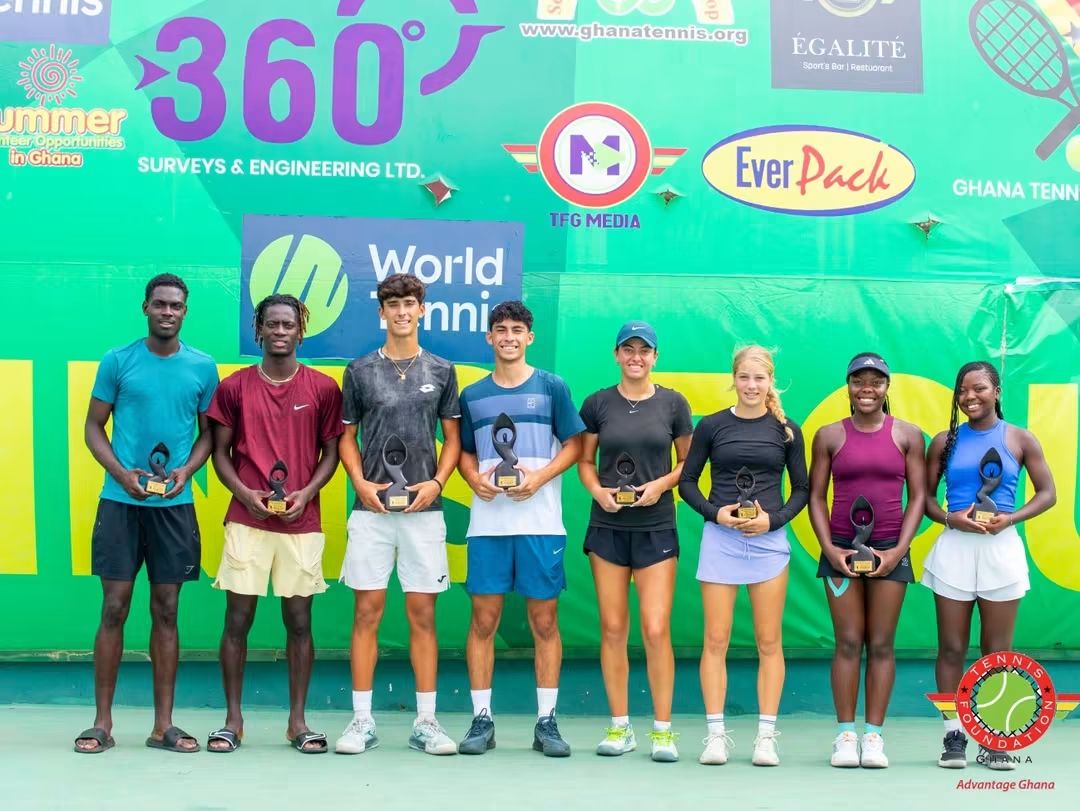
ACCRA, Ghana — Six weeks of international junior tennis, outstanding individual performances, emerging talents and unforgettable championship battles came to a memorable conclusion on October 10, 2026, as the ninth annual Tennis Foundation Ghana (TFG) / World Tennis Tour Juniors series wrapped up at the National Tennis Centre inside the Accra Sports Stadium.
From August 31 to October 10, the tournament transformed the Accra venue into a meeting point for promising young tennis players from Ghana, across Africa and other parts of the world, offering them a valuable opportunity to compete internationally, earn junior ranking points and take important steps towards their ambitions in the sport.
Held under the auspices of the Ghana Tennis Federation (GTF), with Tennis Foundation Ghana at the heart of the tournament’s organisation, the six-week series featured three successive competition blocks: the J30, J60 and J100 events. The progression provided a demanding competitive environment in which young athletes could test their skills, build confidence and measure themselves against international opposition.
The tournament was staged on the hard courts of the National Tennis Centre, with the J100 Accra – Tennis Foundation Ghana Open bringing the six-week programme to its conclusion.
Beyond the trophies and final scores, the series demonstrated the value of sustained international competition in developing young tennis players and strengthening Ghana’s place on the junior tennis calendar.
A six-week journey from J30 to J100
The tournament’s structure was one of its most significant features. Rather than offering players a single week of competition, the series provided a continuous pathway through three levels of junior tennis, allowing participants to gain match experience and compete against a wide range of opponents.
The opening J30 tournaments, held from August 31 to September 12, introduced the series with a mixture of local promise and international quality. The J60 competitions followed from September 14 to 26, before the J100 events ran from September 28 to October 10.
Each stage brought its own challenges, with the J100 providing a fitting climax to a tournament that had steadily raised the competitive stakes.
The main-draw format for the opening J30 stage also introduced a round-robin system in which players were placed in groups of four, with group winners progressing to the knockout quarter-finals. This gave competitors a guaranteed minimum of three matches in the group stage and created more opportunities for valuable court time. The later stages of the series offered further opportunities for players to demonstrate their consistency, tactical awareness and ability to perform under pressure.
The tournament also benefited from the resurfaced courts at the National Tennis Centre and the involvement of certified chair umpires, contributing to the delivery of an international-standard competition environment.
For many of the young athletes, the series was about more than winning. It was an opportunity to learn how to manage difficult matches, recover from setbacks, adapt to different playing styles and develop the mental strength required to succeed at the highest levels of junior tennis.
J30: Ghanaian talent makes an early statement
The opening stage delivered one of the tournament’s most encouraging stories for Ghana as Gwendolyn Duvor Klu emerged as the girls’ singles champion.
Klu defeated Togo’s Winner Gakpo in the final, securing the first major singles title of the series for a Ghanaian player. She then teamed up with Gakpo to capture the girls’ doubles crown, completing an impressive singles-and-doubles double.

Their success demonstrated the benefits of regional competition and the potential for partnerships between players from different countries to produce memorable results.
China’s Ruoyu Hua won the boys’ singles title after defeating Ghana’s Jeff Frimpong, who enjoyed a strong run to the final on home soil. Frimpong also featured in the boys’ doubles final alongside Britain’s Denzell Darkey, although the pair were unable to complete their campaign with a title.
Israel’s Yarden Shalom Gamliel and India’s Shivtej Shirfule claimed the boys’ doubles championship.
The opening stage therefore provided a compelling mix of Ghanaian achievement and international success. Klu’s double triumph was a major highlight, while Frimpong’s appearances in two finals offered further encouragement for Ghanaian junior tennis.
J60: Rising stars demonstrate their consistency
The J60 stage raised the level of competition and produced another series of impressive performances.
American David Beckles and Dutch player Pippa Fennis emerged as major singles winners, with Fennis particularly outstanding during her campaign in Accra.

The Dutch teenager captured consecutive J60 girls’ singles titles, establishing herself as one of the most consistent performers of the middle stage of the series. Her success reflected the importance of concentration, match management and the ability to reproduce high standards across successive tournaments.
Beckles also demonstrated his quality in the boys’ competition, recording important victories against a competitive international field.
The doubles events added further variety to the championship programme. Spain’s Javier Montes Jimenez and Raul Sanchez Romero claimed the boys’ doubles title, while Fennis partnered Milana Kolesova to win the girls’ doubles crown.
For Ghanaian players, the J60 tournaments provided another opportunity to test themselves against international opposition. Competing against players with different styles, training backgrounds and tactical approaches can help local athletes identify areas for improvement and gain experience that is difficult to replicate through domestic competition alone.
The J60 stage also underlined the importance of regular international tournaments in helping junior players develop the resilience and consistency required to progress through the rankings.
J100: A thrilling finale and memorable championship performances
The final two weeks delivered some of the series’ most compelling tennis, with the J100 Accra – Tennis Foundation Ghana Open attracting strong competition in both the boys’ and girls’ draws.
The J100 title contests produced dramatic matches, comebacks and outstanding displays of composure, providing an appropriate conclusion to six weeks of competition.
Sydney Wright completes a remarkable Accra double
One of the biggest stories of the entire series was the performance of American Sydney Wright, who captured back-to-back J100 girls’ singles titles in Accra.
Wright won the first J100 girls’ singles championship after defeating Poland’s Alisha Ndukwu in a gripping final, 6–3, 4–6, 7–6(4). The three-set encounter demonstrated Wright’s ability to remain composed during a demanding contest and deliver when the title was on the line.
Her campaign included a commanding 6–3, 6–0 victory over second seed Milana Kolesova in the semi-finals.

Wright returned for the final week and again demonstrated her quality, defeating Zimbabwe’s Kuzivaishe Chapepa 6–2, 6–0 to claim her second consecutive J100 girls’ singles crown.
Winning one J100 title is a significant achievement for a junior player; returning the following week and winning again requires consistency, physical preparation, tactical discipline and the ability to handle the expectations that accompany success.
Wright’s double triumph therefore stood among the defining achievements of the six-week series.
Dev Vipul Patel wins the final boys’ singles title
India’s Dev Vipul Patel produced another headline performance by winning the final-week J100 boys’ singles championship.
In an all-Indian final against sixth seed Om Verma, Patel recovered from a difficult second set to claim a 6–3, 0–6, 6–4 victory.

After taking the opening set, Patel was completely outplayed in the second as Verma won six consecutive games to level the match. The decisive set demanded a response, and Patel found the discipline and composure to regain control and secure the championship.
The victory was especially significant because it completed Patel’s campaign with the final boys’ singles title of the series.
Verma also enjoyed an outstanding tournament. He had won the previous J100 boys’ singles title after defeating American David Beckles 6–3, 6–3, before reaching the final again in the last week. His ability to return to another championship match underlined his consistency throughout the closing stages.
Doubles finals provide more drama
The doubles events added another layer of excitement to the J100 finale.
In the girls’ doubles, Nigeria’s Success Ogunjobi and Wright combined effectively to defeat top seeds Kolesova and Ndukwu 6–3, 6–1. Their performance demonstrated the importance of communication, court coverage and coordinated attacking play in doubles tennis.
The boys’ doubles final delivered one of the most dramatic finishes of the tournament. India’s Om Verma and Kenya’s Zayyan Virani defeated defending champions Mannan Ashok Agarwal and Dev Vipul Patel 7–5, 3–6, 14–12.
The match required the winning pair to hold their nerve in a deciding match tiebreak, where a handful of points can determine the outcome of an entire championship.
Verma’s doubles victory was particularly notable because he had also reached the boys’ singles final. Although he missed out on the singles title, he finished the week as a doubles champion, while Virani celebrated an international tournament victory alongside his Indian partner.
The results captured the unpredictable nature of junior tennis, where a player’s success can come through different combinations of individual skill, teamwork and mental resilience.
International participation enriches the competition
One of the most valuable aspects of the series was its international character.
Players from Ghana, Nigeria, Togo, Zimbabwe, India, the United States, the Netherlands, China, Poland, South Korea, Spain, France, Kenya, Israel and other countries featured across the various competitions.
This international mix created opportunities for athletes to exchange experiences, encounter unfamiliar playing styles and build relationships through sport.
For the West African players, the tournament offered the opportunity to compete for international ranking points without having to travel overseas for every competitive opportunity. For visiting players, Accra provided a setting in which to test their skills against a diverse field while experiencing Ghanaian hospitality and the country’s tennis environment.
The series also illustrated the increasingly international nature of junior tennis. Progress in the sport requires more than talent alone; young players need access to competitive matches, quality coaching, appropriate facilities, international exposure and the financial and logistical support required to sustain their development.
By bringing multiple tournament weeks to Accra, the TFG / World Tennis Tour Juniors series helped create an environment in which these elements could come together.
Ghanaian juniors gain valuable experience on home soil
Although visiting players claimed several major titles, the tournament’s importance for Ghana should not be measured solely by the number of trophies won by local athletes.
International competition provides a valuable benchmark for assessing the progress of domestic players. Facing opponents from different tennis cultures can expose weaknesses, sharpen decision-making and encourage young athletes to raise their standards.

Klu’s J30 double triumph and Frimpong’s run to two finals were important early highlights. Ghanaian players also had the opportunity to compete against internationally ranked juniors throughout the J60 and J100 stages.
Such exposure is especially important for developing athletes who aspire to progress to higher levels of junior competition and eventually enter the professional game.
The presence of young Ghanaian players alongside international competitors also offers an opportunity for coaches, administrators and talent developers to assess the depth of local talent and identify areas where further investment may be needed.
The long-term value of the series will depend partly on how effectively players translate their experience into improved performances in subsequent domestic and international competitions.
Organisation, facilities and the people behind the tournament
A tournament of this scale requires sustained coordination across several weeks, from player entries and match scheduling to officiating, court preparation and the delivery of championship ceremonies.
Tennis Foundation Ghana played a central role in staging the series, with Roger Crawford serving as president of the foundation and tournament director. The Ghana Tennis Federation’s role under the tournament’s auspices was also important in placing the competition within Ghana’s organised tennis framework.

The National Tennis Centre at the Accra Sports Stadium provided the venue for the six-week programme, while the resurfaced courts and certified chair umpires contributed to the competition environment.
The tournament’s partners and supporters also formed part of the wider effort to sustain junior tennis opportunities. The series’ associated names included Verna Mineral Water, Accra City, Legacy Rise Sports and Egalité Sport’s Bar/Restaurant.
Support for junior sport extends beyond the provision of a venue. Successful tournaments depend on cooperation among organisers, officials, players, coaches, sponsors, families, volunteers and media professionals.
Their combined efforts help ensure that athletes can compete in a structured environment and that the public has opportunities to follow the achievements of the next generation.
The completion of six weeks of competition was therefore not simply a sporting milestone; it was also the result of a sustained organisational effort.
The role of media in telling the tournament’s story
The tournament’s significance extended beyond the courts. Across the six weeks, media coverage helped document the results, celebrate the champions and bring the performances of emerging players to a wider audience.
As a media professional covering the series from the J30 through the J60 and J100 stages, I witnessed the tournament’s progression from its opening matches to its final championship battles.

Each stage presented a different story: the promise of emerging Ghanaian players, the consistency of international competitors, the intensity of the knockout rounds and the emotion of the final trophy presentations.
Covering a multi-week junior tournament also reinforces an important point about sports journalism: the work does not end with reporting a score. It involves identifying the significance of a performance, preserving the stories of young athletes and helping audiences understand the people and development pathways behind the results.
The photographs, match reports, interviews and championship updates produced throughout the series form part of the wider record of the tournament.
For the players, these records help preserve important moments in their early careers. For Ghanaian tennis, they provide a continuing account of the country’s role in hosting international junior competition.
Beyond the trophies: building a pathway for the future
The ninth annual series leaves behind a set of results, champions and memorable matches, but its broader significance lies in the opportunities it created.
For young athletes, regular international competition can build confidence and provide a clearer understanding of the standards required to progress. For Ghanaian tennis, hosting the series creates a platform for local players to measure themselves against international opposition and for the sport to reach new audiences.

However, the next challenge is to ensure that the benefits of the tournament continue after the final ball has been struck.
Sustained investment in coaching, junior development, facilities, competition opportunities and athlete welfare will be essential if the experience gained in Accra is to translate into long-term progress.
Ghana also has an opportunity to use tournaments of this kind to encourage greater participation among children and young people, strengthen the relationship between schools and tennis development programmes, and inspire more families to see the sport as an accessible pathway for recreation and competitive achievement.
The tournament alone cannot guarantee future international success, but it can form an important part of the structure needed to nurture talent.
The challenge for organisers and stakeholders is to build on the momentum, retain the lessons learned and create further opportunities for young players to compete and develop.
A fitting conclusion to six weeks of tennis
From Ruoyu Hua and Gwendolyn Duvor Klu’s early J30 triumphs to the consistency of Pippa Fennis at J60, and from Sydney Wright’s back-to-back J100 girls’ singles titles to Dev Vipul Patel’s final-week boys’ singles victory, the 2026 Tennis Foundation Ghana / World Tennis Tour Juniors series delivered a compelling account of ambition, resilience and sporting excellence.
The doubles competitions brought their own champions and dramatic finishes, while Ghanaian players gained valuable opportunities to compete against international opponents on home soil.
Over six weeks, the National Tennis Centre became more than a venue for championship matches. It became a meeting point for young athletes pursuing similar ambitions, a platform for international exchange and an opportunity to showcase Ghana’s capacity to host junior tennis competition.
As the ninth annual series concluded on October 10, the lasting measure of its success will be found not only in the trophies lifted in Accra but also in the lessons learned, the experience gained and the opportunities that follow for the players who competed.
For Ghanaian tennis, the hope is that the tournament’s legacy will extend well beyond six weeks — inspiring the next generation, strengthening junior development and helping more young athletes take their first meaningful steps towards the international stage.
The final scores may be recorded in the history books, but for many of the young players who competed in Accra, the journey is only beginning.