

Kofi Adams calls for deliberate rebuilding of Ghana football at GFA Congress

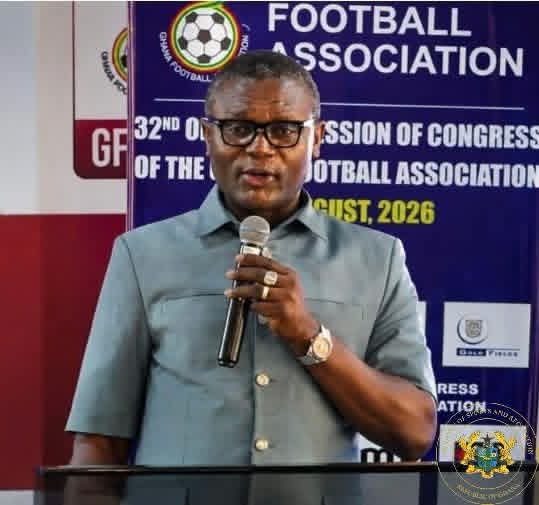
Minister for Sports and Recreation, Hon. Kofi Iddie Adams, has called for a deliberate and comprehensive rebuilding of Ghana football, warning that the country must move beyond short-term interventions and begin building a sustainable football industry.
Speaking at the 32nd Ordinary Congress of the Ghana Football Association (GFA), Kofi Adams said Ghana possesses the history, talent, supporters, clubs, corporate sector and football identity needed to become a dominant force, but questioned whether the country was getting enough value from those assets.
According to him, the answer is no, insisting that Ghana football needs more than cosmetic changes, isolated competitions and programmes that produce little measurable impact.
“At some point, we must accept that Ghana football requires rebuilding. Not cosmetic changes, not another scattered competition, workshop or programme that exists beautifully on paper but cannot be seen in the development of the player, the strength of the club, the quality of the league or the connection with the supporter. We need a deliberate rebuild,” he said.
Need for a clear player-development pathway
The Sports Minister expressed concern over the decline of Ghana’s traditional player-development conveyor belt, which previously saw talented youngsters progress from Colts football through the national youth teams before eventually reaching the Black Stars.
He questioned whether Ghana could currently identify its best young players at U-13 level, track their progress through U-15 and U-17 football, and understand why some players eventually drop out of the system.
Kofi Adams argued that modern football development must be built around deliberate talent identification, quality coaching, sports science, competition exposure, player data and structured transition.
“Talent identification is deliberate. Coaching is deliberate. Sports science is deliberate. Competition exposure is deliberate. Player data is deliberate. Transition is deliberate. We cannot compete with deliberate systems through hope,” he stated.
He proposed a football pathway covering participation, identification, development, competition, progression, elite transition and professionalisation, with standards, data, qualified personnel and accountability at every stage.
Clubs must build institutions, not just players for sale
The Minister also challenged club owners to rethink the way they run their institutions, urging them to build sustainable clubs rather than teams dependent on player sales.
He said clubs must develop assets such as supporters, academies, facilities, player contracts, data, digital audiences, commercial partnerships, merchandise and strong community relationships.
“If the only asset we are building is the next player we intend to sell, our clubs will remain financially fragile,” he warned.
Kofi Adams said Ghana should continue to develop and export players, but the process must involve identifying, developing, playing, marketing and increasing the value of players before intelligent transfers and reinvestment.
He also called on clubs to deliberately create stars capable of attracting supporters to the domestic league.
Reflecting on the past, he cited former league stars such as Charles Taylor, Don Bortey, Ishmael Addo and Stephen Oduro as examples of players who captured the imagination of supporters.
He questioned who the current stars of the Ghana Premier League are and whether clubs are doing enough to build the profiles and market the personalities of talented players.
“You cannot sell a league without selling its characters,” he said.
Accountability for government investment
The Sports Minister highlighted government interventions in domestic football, including the provision of GH¢1 million to every Premier League club and efforts that contributed to increasing the Ghana Premier League championship prize from GH¢500,000 to GH¢2 million, with financial rewards extended to clubs down the league table.
However, he challenged clubs to demonstrate what those investments had actually built.
He asked whether the funds had resulted in stronger commercial departments, supporters’ databases, improved medical systems, academies, club shops, digital ticketing, better content production or new revenue streams.
“If GH¢1 million entered a club at the beginning of the season and the institution looks exactly the same at the end, then we financed a season, not transformation,” he said.
Kofi Adams stressed that government cannot continue providing financial support without evidence that the money is helping clubs develop sustainable revenue-generating structures.
Fan engagement must go beyond matchday promotion
The Minister also called for a major rethink of how clubs engage supporters, arguing that football must earn the attention of fans in an increasingly competitive entertainment environment.
He said Ghanaian football now competes with the English Premier League, UEFA Champions League, TikTok, streaming platforms, gaming and other digital entertainment.
He therefore urged clubs to know their supporters, including attendance patterns, membership, season-ticket ownership, geographical location and purchasing habits.
“If we cannot measure our audience, how do we sell that audience to sponsors?” he asked.
Kofi Adams further called for loyalty programmes, club shops, replica jerseys, scarves, training wear, signed products and online stores to give supporters more ways to connect financially and emotionally with their clubs.
He also urged clubs to turn their history into commercial and cultural assets through museums, trophy experiences, heritage tours, documentaries and legends programmes.
Content must become football infrastructure
According to the Minister, content creation must now be treated as an essential part of football development.
He said clubs should use training sessions, player stories, rivalries, statistics, supporter stories, academies, history and behind-the-scenes material to keep fans engaged throughout the week.
“Content creates attention. Attention creates audience. Audience creates commercial inventory. Commercial inventory attracts sponsors. Sponsorship creates resources for development,” he explained.
He stressed that the same commercial and developmental thinking must extend to Division One, Division Two, Division Three and Colts football because the Premier League cannot become strong on a weak foundation.
Hooliganism and stadium safety
Kofi Adams also addressed hooliganism, describing the death of Asante Kotoko supporter Francis Nana Yaw Frimpong, popularly known as Nana Pooley, during the tragedy at Nsoatre in February 2025 as a permanent warning to Ghana football.
While acknowledging measures introduced by the GFA following the incident, he said responsibility for violence must not be placed solely on supporters.
He noted that club officials, technical teams and players can also contribute to tensions around matches and urged club leadership to demonstrate responsible behaviour.
“Nobody should leave home to watch football and fail to return home because of football,” he stressed.
He argued that stadium safety is also a commercial issue, as parents may refuse to bring their children to matches, sponsors may hesitate to associate their brands with violence and broadcasters may be unwilling to showcase disorder.
Women’s football and national teams
The Minister said Ghana’s ambitions for the Black Stars and Black Queens must be matched by investment in the systems that produce players.
He said the progress of the women’s national teams must translate into stronger women’s clubs, greater participation, improved coaching, better welfare, increased sponsorship and a stronger pathway for female players.
“The national team must be the top of the pyramid. If the top is getting stronger, the base must grow with it,” he said.
Match integrity and refereeing
Kofi Adams also raised concerns about match manipulation, illegal betting and the credibility of domestic competitions.
He acknowledged the GFA’s integrity structures, training programmes, reporting channels and collaboration with the Criminal Investigations Department, but questioned whether those measures had translated into increased public confidence.
He stressed the need to distinguish between honest refereeing mistakes and persistent concerns about officiating, arguing that confidence in the competition can suffer when clubs and supporters repeatedly question the competence or independence of referees.
With Ghana yet to introduce VAR in domestic competitions, he called for greater investment in referee training, fitness, assessment, integrity and performance management.
“Protection must also come with accountability, continuous assessment, transparent performance management and consequences where standards are consistently not met,” he said.
Regional centres of excellence needed
The Sports Minister further advocated the establishment of regional or zonal football development centres to complement national structures.
He said one national centre cannot develop all of Ghana’s talent and proposed functional centres connecting school football, Colts, academies and regional competitions to a national high-performance system.
Such centres, he said, should provide quality pitches, qualified coaches, sports science, medical screening, video analysis, player data and structured talent camps.
Ghana Sports Fund must build capacity
Kofi Adams also outlined the potential role of the Ghana Sports Fund, warning that it must not become another source of money used merely to finance existing problems.
He said investment from the Fund must produce measurable outcomes, whether in Colts football, coaching, facilities, clubs or talent identification.
“Government funding must help football grow, not simply help football survive,” he stated.
He also called for commercial growth at the top of Ghana football to benefit development at the grassroots, arguing that increased sponsorship and league revenues must eventually be reflected in the quality of football produced.
From managing seasons to building an industry
In his concluding remarks, Kofi Adams urged Ghana football stakeholders to shift from managing football season by season to building a sustainable football industry.
He said a true football industry should develop talent, create jobs, build infrastructure, produce media and intellectual property, develop brands, generate commercial value, export talent strategically and create opportunities for young people.
“Activity is not the same as impact,” he said, challenging stakeholders to measure success by player development, stronger clubs, increased attendance, growing revenues, higher player values, competitive youth teams, stronger women’s football and deeper community connections.
He ended by posing a series of questions to government, the GFA and club owners: “What are we building? Who are we developing? Who are we asking Ghanaians to come and watch? What value are we creating for the supporter? What did the money we invested last season actually build? And five years from today, what will be fundamentally different about Ghana football because of the decisions we make now?”
Kofi Adams concluded with a call for a new era of deliberate action.
“The time for managing decline must end. The time for deliberate rebuilding must begin,” he said.